Showing posts with label US Navy. Show all posts

Wednesday, May 30, 2012

Why the USS Scorpion (SSN 589) Was Lost: The Death of a Submarine in the North Atlantic By Bruce Rule


Why the USS Scorpion (SSN 589) Was Lost: The Death of a Submarine in the North Atlantic
By Bruce Rule
9781608881208 2011 Self-Published

This book is not a traditional historical text, but instead a compilation of materials related to the tragic loss of USS Scorpion in 1968.
The book contains a number of tables, correspondence and graphs that largely debunks, via information in the public domain, that Scorpion had been sunk by the Soviet Navy. Mr Rule has come to the same conclusion as many historians – Scorpion was sunk by one of her own MK37 torpedoes that somehow managed to start itself while in the tube. Although not mentioned in this work, the torpedo is widely believed to have been fitted with a nuclear warhead, a regular occurrence in Cold War ASW operations. Luckily it appears the warhead never exploded.
Such a detailed work, a labor of love by the author, will likely only be of interest to serious students of submarine operations and naval history. We certainly commend Mr Rule for his efforts to bring the Scorpion story to life again; a difficult undertaking as most official records are still classified.

One Marine’s War A Combat Interpreter’s Quest of Humanity in the Pacific


One Marine’s War A Combat Interpreter’s Quest of Humanity in the Pacific
By Gerald A Meehl 9781612510927 Naval Institute Press 2012


Growing up in Shanghai in the 1930s, Mr Sheeks had an opportunity to develop a familiarity with Asiatic languages. Studying at Harvard at the time of the Pearl Harbor attack, Sheeks was quickly recruited by the US Navy for language translation duty in the Pacific for the US Marine Corps. Extensive training in the Japanese language followed in California and Colorado before leading to active duty in the invasions of Tarawa, Saipan and Tinian.
The book certainly educates the reader on the heretofore little known work of the translators during combat operations and behind the front lines.  A worthy addition to the historical record of the war against Japan in the Pacific and is recommended.

Monday, May 7, 2012

Pearl Harbor to Coral Sea The First Six Months of the Pacific War


pearl harbor to coral sea
Pearl Harbor to Coral Sea
The First Six Months of the Pacific War
Compiled by Neil Robinson | Illustrated by Peter Scott
£19.99 100pp
70th Anniversary Special highlighting color schemes and markings carried by the Imperial Japanese Navy’s pre-emptive strike force aircraft and the defending USAAC and USN / Marine aircraft based at Pearl Harbor and then the Battle of Midway.
Representative aircraft from all six IJN carrier Divisions with explanation of the IJN’s coding systems and aircraft markings. Compiled by Neil Robinson | Illustrated by Peter Scott. Comprehensive selection of the aircraft that took part – from both sides
Follow-on coverage of all the other areas and aircraft involved in the first six months of the Pacific War up to the turning point at the Battle of Midway in June 1942. For the modeler, history or aviation enthusiast, this book is a must for their collection.

Tuesday, March 20, 2012

Profiles of Flight: Vought F4 Corsair Carrier and Land-based Fighter


ISBN: 9781848844087 - Vought  F4 Corsair
Profiles of Flight: Vought F4 Corsair Carrier and Land-based Fighter 

Dave Windle
9781848844087 Pen & Sword Books $39.95

Beautifully illustrated with color profile artwork and black and white photos with the photos of deck landing training on training carrier USS Charger which spend most of the Second World War undertaking this duty off the Virginia Capes. This book would be an excellent addition to the collection of aviation fans and modelers. Well done to Mr Windle on what was obviously a labor of love. 


Vought F8 Crusader 1955-1999


Vought F8 Crusader 1955-1999
Gérard Paloque
Paper 9782352501855 Histoire & Collections $24.95

This book is very well researched and illustrated by French author Gérard Paloque. Profusely illustrated with photographs and first rate artwork. The Vought Crusader was the last jet fighter able to deploy on any US Navy carrier of the period and was used extensively in the Vietnam War. In addition the aircraft was used by the French Navy for many years. One small beef with this book was the awkwardness of some of the translations from the original French, something that should have been caught in editing. However the overall book is superb and must for any fan of naval aviation.


Tuesday, February 15, 2011

US Navy Warships & Auxiliaries including US Coast Guard


By Steve Bush

216 pages Maritime Books; 2nd Revised Edition (December 2010)
English 1904459439 978-1904459439 8
£7.99 | $12.45
The 2nd Edition of this pocket sized guide to the ships, submarines and aircraft of the US Navy, Military Sealift Command and Ready Reserve Fleet has been expanded to include the ships & aircraft of the US Coast Guard. This reviewer looks forward receiving the next work from Steve Bush and this book does not disappoint. This work is profusely illustrated with color photographs of the ships and aircraft of the US Navy, Military Sealift Command and US Coast Guard covers all but the smallest craft. This book is truly a timely reference tool at an affordable price.

Wednesday, October 27, 2010

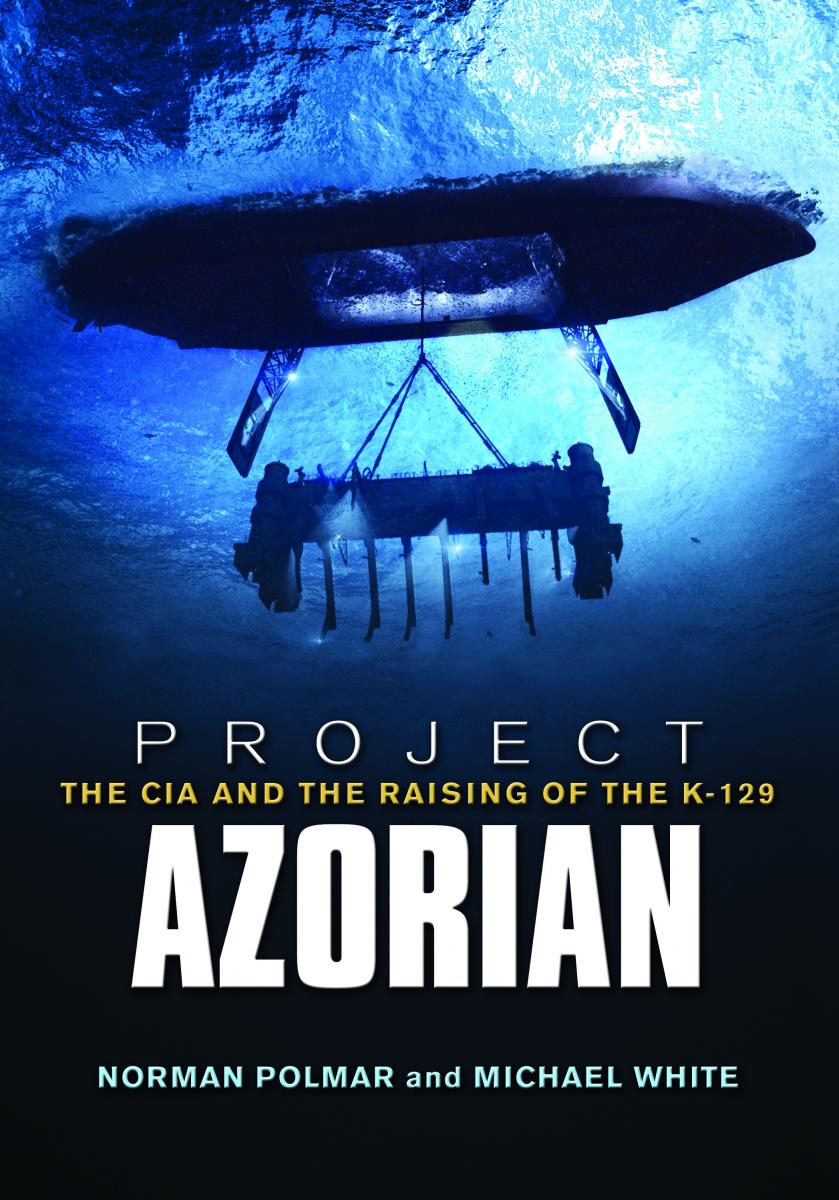
PROJECT AZORIAN—The CIA and the Raising of the K-129

PROJECT AZORIAN—The CIA and the Raising of the K-129


By Norman Polmar and Michael White


Naval Institute Press, 2010 ISBN/SKU: 9781591146902. $29.95 US list price.

The book Project Azorian describes the Nixon Administration’s attempted salvage of the Soviet Golf-II submarine in 1974, based on CIA records. It is a quick read, about 180 pages less illustrations. Interesting items include:
• Very good illustrations and diagrams provide much technical information.
• The submarine was lost when two of its liquid-fuel missiles ignited inside their launch tubes and fractured the submarine.
• The salvage project focused on recovering the third missile in its tube, which was the forward-most of three, along with the bow section forward of it;
• The Soviet embassy in Washington received an anonymous revelation of the operation but no known reaction resulted.
• According to the ComSubPac plans officer at the time, should USSR ships seize the recovery ship Hughes Glomar Explorer, USS Tautog (SSN 639) and another submarine carried WW2 anti-ship torpedoes specifically to sink her, a contingency not told to the crew of the recovery ship.
• A supposed attempt to dig further under the Soviet submarine strained the huge recovery mechanism, nicknamed Clementine, and resulted in the loss of most of the salvaged section during the ensuing hoist.
The authors of Project Azorian say little about what actually was learned but somewhat wishfully ask the reader to regard the operation as successful. Project Azorian challenges particular statements in other books and newspaper articles but is silent about contradictory analyses that have previously appeared:
• The book Blind Man's Bluff—The Untold Story of American Submarine Espionage by Sherry Sontag and Christopher Drew (2000) stated that USN personnel suggested use of submarines and vehicles to break open the hull to salvage the contents, instead of waiting six years for the huge grappling device that fractured. Blind Man’s Bluff is a cited reference in Project Azorian.
• A past television program, not the upcoming program associated with the book Project Azorian, quoted one participant that when the submarine section lifted free from the sea bed, the resulting sudden increase in buoyed mass caused Hughes Glomar Explorer naturally to settle deeper in the water. The suspended submarine and the grappling mechanism crashed back on the sea bed. According to the program, that impact was the cause of the structural damage to the mechanism.
• Blind Man’s Bluff contends that the hull structure, which was the primary item that the CIA’s mission could obtain over the Navy’s proposed alternative, had little value for intelligence purposes.
• The National Security Archive at The George Washington University posted on February 12, 2010, the web page “Project Azorian—The CIA's Declassified History of the Glomar Explorer” (http://www.gwu.edu/~nsarchiv/nukevault/ebb305/index.htm). A director with the National Security Archive commented there that the operation “resembles the Bay of Pigs more than U-2 or Corona.”
Items that this reviewer adds:
• The acceptance of the six-year duration for this operation, against the alternative faster USN proposal, suggests that recovery of Soviet crypto gear and publications, offered as one justification for the huge project, had no urgency. The risk of disclosure was high and occurred during the six-year duration.
• The above TV program did not mention that the dynamic change in buoyancy is known in salvage, which suggests that the interviewed participant did not know of it, which in turn suggests that actual salvage expertise was missing from conception to the end.
• In terms of project management, and also in terms of a military commander’s estimate of the situation, the planning phase for this operation should have recognized that multiple risks of the chosen method were very high and were of a nature that no increase in time and resources could recover.
Project Azorian contains source notes, an index, and as mentioned, very good illustrations. This is the first public access to relevant newly-declassified documents and to the authors’ interviews of former Soviet personnel. Project Azorian is inexpensive and easy to read and adds significant authoritative information, including many dramatic details, to Blind Man's Bluff. While a comprehensive analysis of this operation has yet to appear, Project Azorian adds greatly to available information.


(MP)